Patients researching dental implants rarely expect bone grafting to come up. The implant itself is the focus of most of their research. So when a dentist recommends a grafting procedure before moving forward with implant placement, it can feel like an unexpected detour.
It isn’t a detour, but an important step that helps create the foundation needed for a stable, long-lasting implant. Understanding why bone grafting for dental implants gets recommended, and what the evaluation involves, makes the overall dental implants procedure a lot less surprising.
Why Jawbone Loss Happens After Tooth Loss
The jawbone helps maintain its density and volume through the stimulation created by healthy tooth roots during normal chewing.
When a tooth is removed, that signal stops. Bone remodeling begins soon after tooth loss, with the most rapid changes often occurring during the first several months. The longer a tooth has been missing, the more significant that loss tends to be. A site that’s been empty for two or three years looks considerably different from one addressed shortly after extraction.
It’s a predictable biological process, and one that implant planning needs to account for directly.
Why Bone Volume Matters for Implant Placement
A dental implant is a titanium post placed into the jawbone, where it integrates with the surrounding bone over several months before a dental crown is attached. For that integration process to succeed, the implant needs adequate surrounding bone to achieve long-term stability, provide adequate width so the implant isn’t sitting too close to the outer edge, and offer enough height to avoid proximity to anatomical structures like nerves or the sinus floor.
When bone volume falls short of those requirements, the implant may not achieve the stability it needs. An implant placed in insufficient bone is at a higher risk of failing to integrate, or of developing problems down the line even if initial placement feels stable.
What Bone Grafting Doe
Bone grafting for dental implants creates the conditions the placement requires. A graft material, which may come from the patient’s own body, a donor source, or a synthetic biocompatible material is placed at the deficient site. Over several months, the patient’s own bone cells fill in around the graft material, supporting the body’s natural bone regeneration and helping create a site that can support an implant.
The result is a site with adequate volume and structure. The implant that goes in after a successful graft has a much better foundation than it would have had otherwise.
Not every grafting procedure adds the same amount of time to the treatment timeline. A minor socket preservation graft placed at the time of extraction is different in scope from a larger ridge augmentation procedure for a site that’s been missing a tooth for years. The imaging and evaluation dictate which approach is appropriate.
How Implant Preparation Is Evaluated at Flower City Dental of Gates
Dr. Deepak Gupta at Flower City Dental of Gates explains: “The first thing I want to see is what the bone actually looks like at the site where the implant would go. That means imaging that shows us width, height, and density. The decision about whether grafting is necessary and what type comes from those images, and it’s not a one-size-fits-all protocol.”
He adds that patients who come in assuming bone loss automatically blocks implant treatment are sometimes surprised by how much is still possible.
Who Might Need Bone Grafting Before Implants
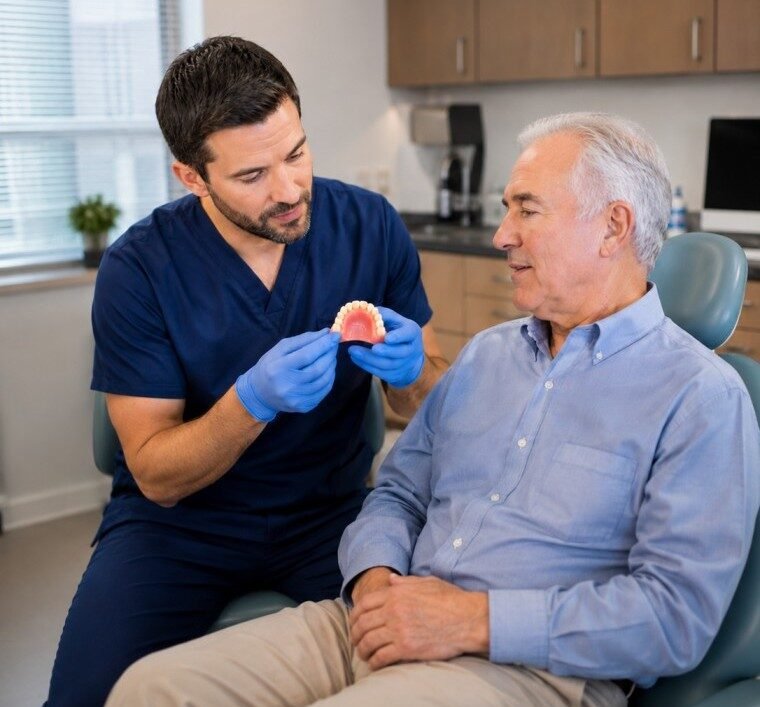
Patients who have been missing a tooth for an extended period are more likely to require some form of bone grafting before implant placement. Patients who lost teeth as a result of gum disease, which itself contributes to bone loss around affected teeth, often present with sites that need rebuilding before an implant is viable. Patients who previously wore dentures for an extended period have also typically experienced significant bone resorption in those areas.
Socket preservation performed at the time of a tooth extraction is one of the more effective preventive measures available for patients who know they want implants. By placing graft material in the socket immediately after removal, significant bone loss can often be reduced. making the eventual implant placement simpler and more predictable than it would be after the bone has already resorbed.
Patients in the Rochester area who are considering restorative dentistry in Gates, NY can also learn whether bone grafting may be recommended as part of their treatment plan.
The Flower City Dental of Gates team walks patients who want dental implants in Rochester NY through imaging, assesses bone health at the implant site, and explains whether a bone graft may be recommended before implant placement.
Appointments are available Monday through Thursday at 2765 Buffalo Road, Suite #2, Rochester, NY 14624. Call 585-485-0292 or visit flowercitydentalofgates.com to schedule.